Why Is English Spelling So Weird?

English spelling is undeniably chaotic. There is an exception to pretty much every rule. However, while it doesn’t follow orderly rules, English spelling does have patterns. I think that learning a little background about how English spelling came to be is both fascinating and helpful.*

There are about 44 phonemes (distinct sounds) in English, depending on the accent. There are only 26 letters. We’ve dealt with this in a few ways:

Sometimes we make a letter do double duty, the way the e in me and in get make different sounds.

Sometimes we combine two letters to make a sound — “sh” or “ou” for example.

Sometimes we spelled two sounds in the same way and figured people could guess by context, the way we do with present and past tense “read.”

Sometimes we wrote down the prettiest spelling.

Mostly, we just got creative, like young spellers still do, and over time conventions arose from repetition.

This would all have been simple enough if everyone spelling had been working together, but early English scribes and printers working in isolation with no standards and varying influences.

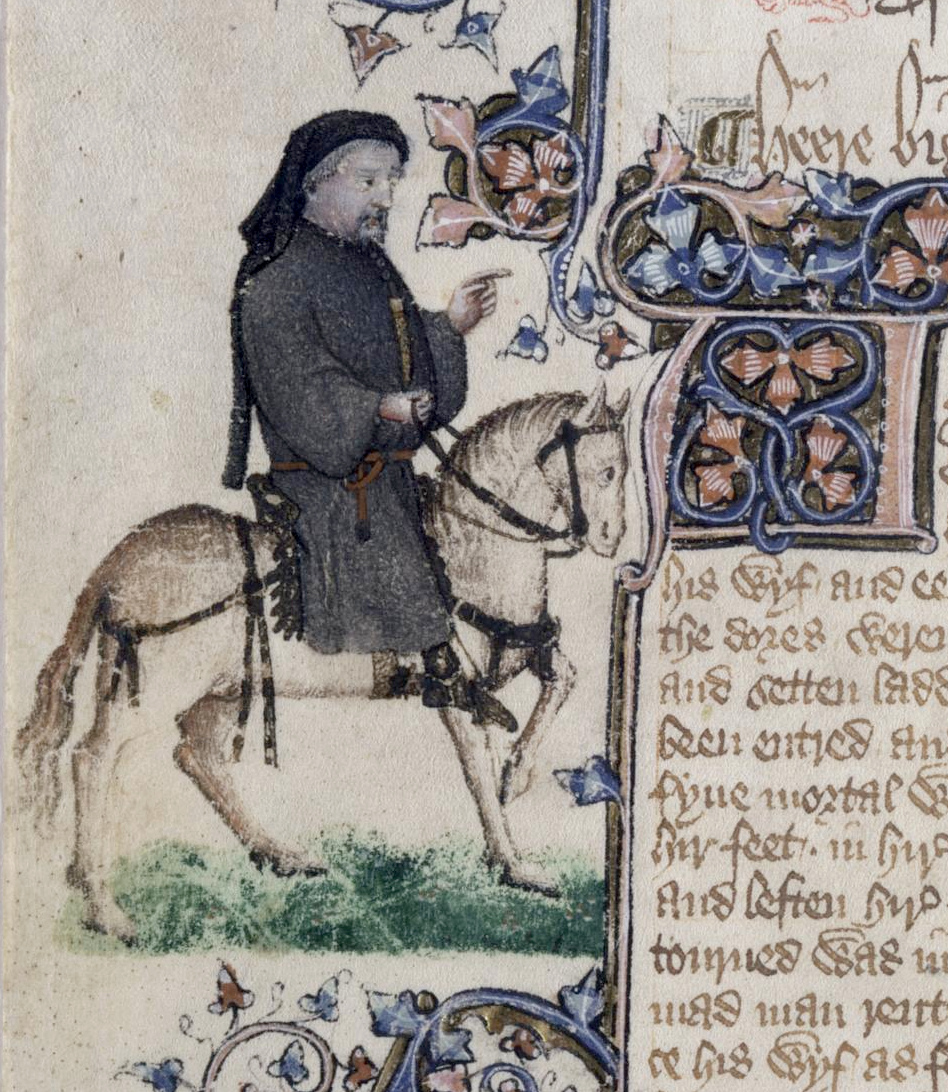
Because many different combinations of letters could be combined to make certain sounds, there were lots of choices about how to spell different words (at least 60 ways to spell “night” have been recorded in Medieval manuscripts), and in each case, different factors prevailed in the conventional spelling that emerged.

French and Latin spelling influenced English words, often against the spelling trends of Anglo-Saxon words. Other times Anglo-Saxon spelling changed the imported French or Latin words. So while we write Old English “pepper” with two p’s to show that it has a short vowel sound (same reason why “hop” becomes “hopped” instead of “hoped”), we don’t double the consonant in the French-import short-voweled words “leper” or “proper.”

Other times, the Anglo-Saxon sense prevailed, giving us doubled consonants in short-voweled French-rooted words like “jolly” and “cabbage” and lots more.

Then there are all the shifts in pronunciation to deal with, not to mention different accents which all use the same spelling. At some point “boot” and “foot,” “blood” and “good,” all had long vowels. They way they are said has changed, but their spelling hasn’t.

And sometimes spellings change to match each other, even when it makes their pronunciation more illogical. We used to say the silent b “dumb.” “Thumb” never had a b sound, but we decided it (and a lot of other words) should look like “dumb” so we stuck one on.

Weird as it is, there is a logic to the spelling of most English words, and most words are spelled like at least a few other words, as they follow incomplete and often conflicting principles. This is one reason that learning spelling words in word families is useful. (More about this in a later post.)

*This post is my synthesis of some of what I learned reading David Crystal’s book about the history of English spelling Spell It Out. I recommend it to any word-nerds out there.
Wild Word Games

Summer feeling looooooong? Here are three crazy word games to occupy minds young and old.

scrabble-243192_1280Bananagram Poetry

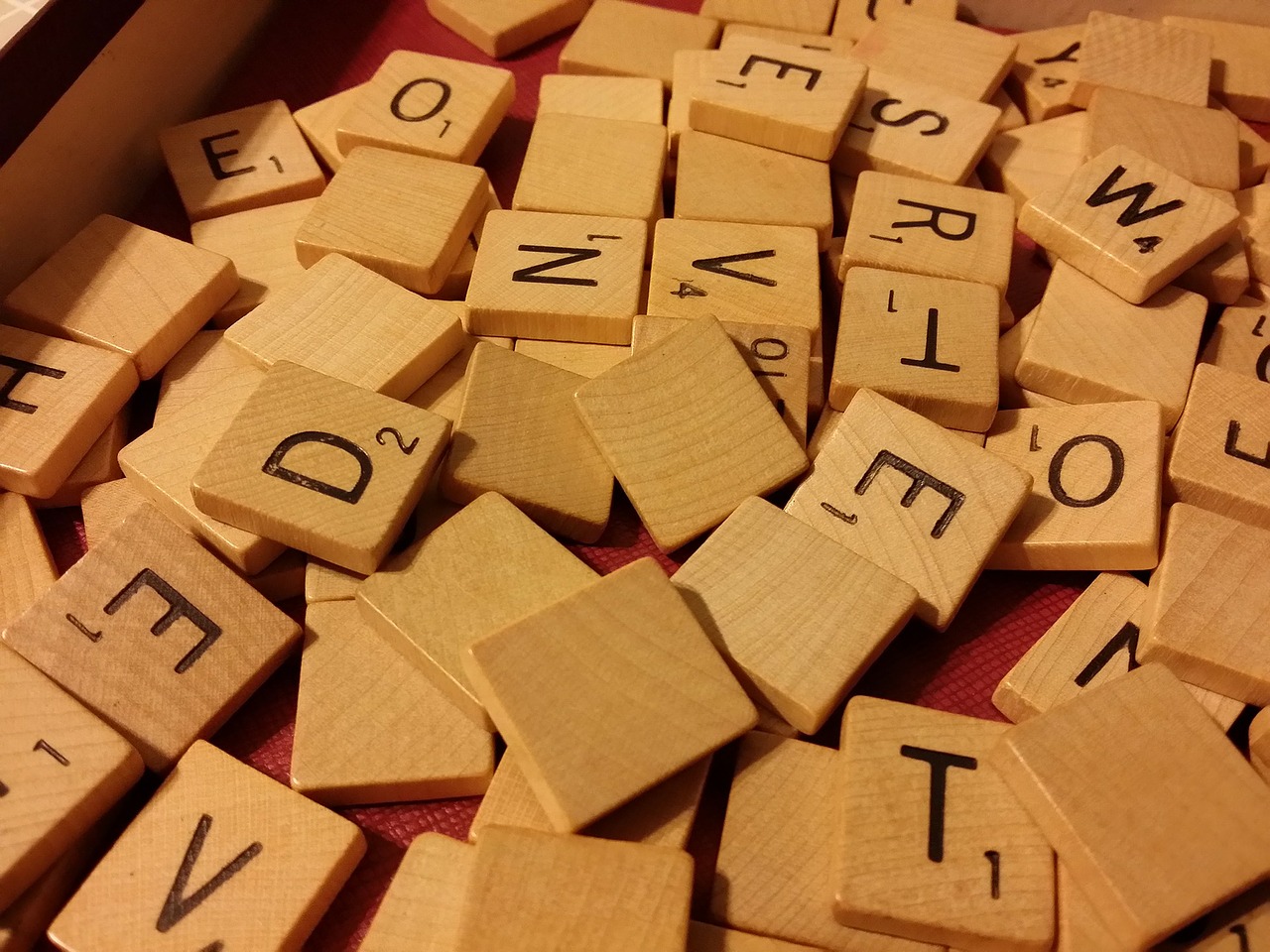
This game works just like Bananagrams (or Speed Scrabble if you play with Scrabble tiles instead of the nifty little banana bag), but after all the game is over there is one more step: everyone moves one place to the left and writes a poem or story using every one of the words in the game in front of them. It is creativity-inducing, sometimes hilarious, and encourages people to leave the cool words in when they are moving their tiles around. Fun with kids or adults.

Don’t Finish the Word 

In this game, the first player says a letter out loud and players take turns adding a letter to begin forming a word. The catch is, if you say the last possible letter that could make a word from the letters that have been building, then you lose.

For instance, the first person might say K, someone might add I, then N. That spells “kin” but no one is out, since someone can add a D to spell “kind.” Since someone else could add an E or an N for “kindergarten” or “kindness” then the game keeps going on until there is nothing that can be tagged on, ending with “kindergarteners” or “kindnesses.” Whoever has to say that last S loses. Or have I missed something? This is a great game for the car.

Best Blank

This game is like Apples to Apples, but without pre-made cards. One person gives a prompt. This could be an adjective like in Apples to Apples or it could be a whole sentence. For instance, the prompt could be “wintery” or it could be “Yum! That’s my favorite!” Or anything even crazier your loved one’s brains invent.

Then everyone else writes the best response they can think of on a slip of paper. It could be something accurate, or something funny. It could be an inside joke, or something just plain weird — whatever they think the prompter will like best.

The prompter reads all the possible answers and picks the best one, whatever that means to them. The person who wrote that answer gets a point, and the prompting rotates to a new player.


8 Ways Homeschooling Creates Success

I can credit homeschooling — unschooling in particular — with developing many of the traits that support me being a successful adult, and I see the same things in other grown-up homeschoolers I know. Here are eight foundations for success that homeschooling fosters:

1. Homeschooling develops self-motivation and self-discipline.

“I could never homeschool! I don’t have enough self-discipline.” People told me that over and over again when I was homeschooling. However, it’s easy to spend time investigating things you are interested in — much easier than doing homework. And all that investigating becomes a habit. You learn to take initiative in your own life and learning. After all, you can’t just sit there while someone else teaches you. Your education is in your own hands (with some adult helpers, certainly), just as your life and career will be as an adult. Also, learning for learning’s sake instead of for grades or outside approval develops internal motivation. I’ve applied these skills towards writing novels, starting businesses, and succeeding in competitive academic environments.

2. Homeschooling rewards proactivity.

We are all responsible for making our own happiness, success, and meaning. Not that this happens in a vacuum, but that it takes proactive initiative on our parts. Because of its open-endedness, homeschooling teaches this early. There is no tide of other students to sweep you along. You either come up with interesting things to do, or you sit around alone being bored. So you learn how to make interesting things happen, which leads to an interesting, proactive life.

3. Homeschooling helps people stay connected to their passions.

Homeschoolers tend to know themselves. They are connected to their passions and are less ashamed of their geekiness and excitement than your average kid. I see this over and over again with the homeschoolers in my class. They come into class rocking crazy clothes. They speak with spastic excitement (and incredible knowledge) about mycology, welding, Latin, explosives — wherever their passions lie. They are confident in their own beliefs, whether they believe in a religion or in fairies or in the infallibility of science or all three. They love things and they aren’t afraid to show it. In other words, homeschooling fosters geekiness. And we all know geeks win in the end.

4. Homeschooling honors people’s inner truth.

What is right for one person is not right for another, and the individualized nature of homeschooling allows kids practical experience in knowing what is true for them. This is a life-skill with endless applications.

5. Homeschooling allows students the immersive focus to develop their strengths.

I’m all for well-roundedness, especially because things don’t stay in the tidy boxes academia makes for them. However, true happiness and success comes from knowing your strengths and playing to them — while not being afraid to challenge yourself. Because of the time and freedom homeschooling allows, it fosters children’s gifts.

6. Homeschooling lets kids fail.

Making mistakes is a critical part of learning — as one friend of mine says “sometimes you win and sometimes you learn.” However, in a grade or peer-pressure based learning environment there isn’t room to fail without being labeled a failure. When a child is messing around with something on their own time and own terms, mistakes can become interesting puzzles and happy accidents. They can feel through the frustration of repeated failure, and keep trying, because the stakes for their sense of self are low. Behind most great successes are a whole string of disastrous failures, and it is only through experiencing failure and learning that it isn’t the end of the world that kids can learn how to take the risks that will let them succeed.

7. Homeschooling encourages natural body rhythms and removes stressors.

In a culture where sleep-deprivation and chronic stress is a norm, following natural body rhythms is radical. Sleeping well, eating well, spending enough time moving and being outside — all of these things are much easier to do as homeschoolers, and establishing these habits as children is a great foundation for health and happiness.

8. Homeschooling teaches people to connect deeply.

Homeschooling is often seen as isolating or even isolationist, and it certainly can be. However, homeschooling encourages deep connections and it can also develop an ability to reach out across differences. I see this in my students’ kindness towards each other and their understanding of each other’s weirdnesses and unique gifts. I see it in the tendency for homeschoolers to be close to people of all ages. I see it in the depth of family bonds of so many homeschooling families. I see it in friendships based on true common ground instead of superficialities, and on the understanding that everyone is weird in their own way, which hopefully develops into an ability to reach past differences towards our common humanity.


Sonnets: Shakespeare wrote ’em so why can’t we?

Sonnets are a staple of English-language poetry. They can also be intimidating to introduce to children, because of their density and formality and because lots of the best ones were written a long time ago. However, I’ve been teaching them — after a solid foundation in other poetry — for several years now, and while the lesson is a challenging one, it opens up whole new areas of poetic awareness. Here are my thoughts on teaching sonnets to children:

While the younger children get some element or another from this lesson, it seems to be most engaging for the ten and up crowd.

We start by learning about metric feet. I explain this as being the beats of a line — you could also say the stresses. We recite the nursery rhyme “Hickory Dickory Dock” while marching around, one step per metrical foot. Everyone gets this pretty quickly. We try taking a step for every syllable, too, to show the difference. Then I write the rhyme on the board, showing where we took each step: HICkory DICkory DOCK. (I use slashes to show the stressed syllables, the ones where we take the step, and flat dashes to show the unstressed, unstepped syllables — it’s hard to do that on this blog.) We notice that there can be a couple of unstressed syllables between stressed ones, like in the word “Hickory.”

Then I pass out a handout with a couple of sonnets on it. Sonnet 130 by Shakespeare is a fun one, as is Love is Not All, by Edna St. Vincent Millay. I tell the class to think of them as puzzles. We start with the puzzle of what they are saying. I read them and translate as necessary.

Then I set the students out to do their own detective work. I tell them to look at one sonnet, and if they like, to see if what they find is true in the other sonnet too. Some students whip through all of the following, while others focus on one element. We try to discover three main things:

1. FEET ~ Where are the feet in the poem? Can they walk them out? Can they mark them?How many are there per line? Is there a pattern?

(Answer: sonnets have roughly five stresses per line, usually mostly in iambic pentameter, which is the rhythm that goes da-DUM, da-DUM, da-DUM, da-DUM, da-DUM, da-DUM. There are enough variations in rhythm in most sonnets that I usually stop with just knowing that there are five beats per line, but many kids instinctually feel the rhythm and put it into their own poems.)

2.RHYME ~ What are the words at the end of each line? Do they rhyme with other end words? Is there a pattern?

(Answer: sonnets can rhyme in a couple of different ways. Both the ones above rhyme in the pattern ababcdcdefefgg. That will make sense if you look at it.)

3. LINES ~ How many lines are there? Are they all their own sentences?

(Answer: sonnets have fourteen lines, but lines aren’t sentences. The new line starts when the old one has its five beats.)

Sometimes we also look at how there is a turn or surprise in the last two lines. Often there is more than enough going on already.

Then, of course, we write our own. I encourage kids who need a challenge to try to write a sonnet that follows all of the rules we discovered. It’s also fine to play with parts of what a sonnet does — to write with a certain number of beats per line, to write with a rhyme scheme, to write a poem that is fourteen lines long, to write the first four lines of a sonnet, to write about love or death or time.